Salesforce Retires Catch-All Inbox For Security Concerns
Salesforce replaces traditional email inbox with AI-powered Security Reporting Agent, according to Salesforce Blog. This change aims to improve security operations efficiency.
Original reporting · salesforce.com
Original: “Securing Salesforce with Salesforce: Retiring the Catch-All Inbox for an Agentic Frontline”
Read “Securing Salesforce with Salesforce: Retiring the Catch-All Inbox for an Agentic Frontline” at Salesforce Blog →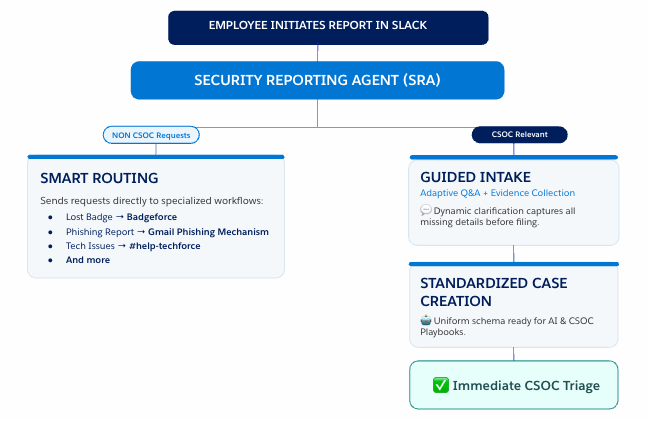
How this was written. Voyager Commercial wrote this article with a language model from Salesforce Blog’s reporting (model: @cf/meta/llama-3.3-70b-instruct-fp8-fast); it describes that reporting rather than adding to it. The original, linked above, is the full story.
Key points from Salesforce Blog’s report
- Salesforce has developed an AI-powered Security Reporting Agent to improve its security intake process.
- The agent has reduced the need for manual triage and improved response times for security concerns.
- The agent is built on Salesforce's own platform, using Slack, Agentforce, and Service Cloud.
Salesforce is rethinking its security intake process to stay ahead of modern threats, which can move from initial access to lateral movement in minutes. The company's security operations teams cannot afford to lose hours sifting through emails. In the past, Salesforce received approximately 110,000 emails regarding security concerns every 18 months, with roughly half coming from employees.
Many of these emails required manual triage, taking up hours of the security team's time. The team had to redirect misrouted requests, chase down missing log details, and decipher ambiguous messages. To address this issue, Salesforce developed the Security Reporting Agent, an AI-powered assistant built on its own platform.
The Security Reporting Agent is a Slack-native assistant that serves as the frontline entry point for internal security concerns at Salesforce. It triages reports, opens structured cases, answers common questions, and routes non-security issues to the right teams. This allows expert responders to focus on high-impact incidents.
The agent was built through collaboration across Salesforce's product, engineering, and operations teams. The product team shifted the model from an invisible backend email parser to an active frontline conversational experience in Slack. The engineering team re-architected the agent on the latest generation of Agentforce, improving response accuracy.
The operations team defined the boundaries of the agent's capabilities, analyzing five years of historical intake data to understand the shape of security demand. The team determined what truly belonged with the security operations team and what was creating unnecessary friction. The agent unites three core technologies: Slack, Agentforce, and Service Cloud.
The Security Reporting Agent has shown promising results in its internal production beta, with 72% of interactions handled entirely on the spot by the agent and 28% of interactions converted into complete, structured cases requiring zero preliminary intake work from human analysts.
Questions and answers
What is the Security Reporting Agent?
The Security Reporting Agent is an AI-powered assistant that serves as the frontline entry point for internal security concerns at Salesforce.
How does the Security Reporting Agent work?
The agent triages reports, opens structured cases, answers common questions, and routes non-security issues to the right teams.
Is the Security Reporting Agent available to Salesforce customers?
No, the Security Reporting Agent is internal reporting for Salesforce employees only. Customers and partners should continue to report security concerns to security@salesforce.com.