Salesforce Introduces Open-Source Benchmark For Contextual Forecasting
Salesforce AI Research has launched GIFT-Eval-CTX, a benchmark to evaluate forecasting systems' ability to use forward-looking context. This development matters because it can significantly improve forecasting accuracy in various industries.
Original reporting · salesforce.com
Original: “Introducing GIFT-Eval-CTX: An Open-Source Benchmark for Contextual Forecasting”
Read “Introducing GIFT-Eval-CTX: An Open-Source Benchmark for Contextual Forecasting” at Salesforce Blog →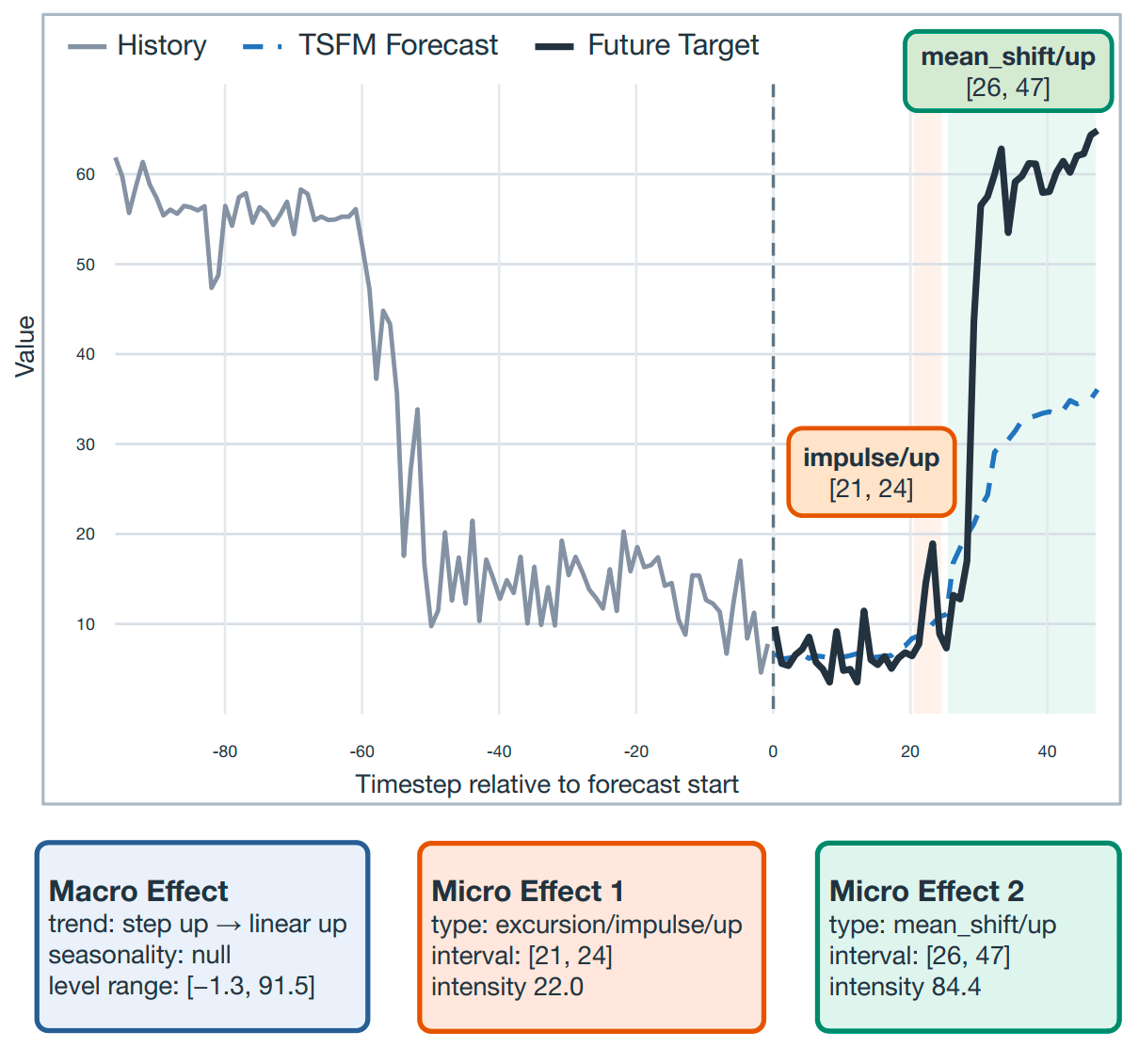
How this was written. Voyager Commercial wrote this article with a language model from Salesforce Blog’s reporting (model: @cf/meta/llama-3.3-70b-instruct-fp8-fast); it describes that reporting rather than adding to it. The original, linked above, is the full story.
Key points from Salesforce Blog’s report
- GIFT-Eval-CTX is an open-source benchmark for evaluating the effectiveness of forecasting systems in using contextual information to make predictions.
- Incorporating structured future context into forecasting systems can significantly reduce error rates and improve forecasting accuracy.
- Agentic systems, which combine large language models with domain-specific models and code execution, can deliver more accurate forecasts than traditional models.
- The GIFT-Eval-CTX benchmark and dataset are fully open source, allowing researchers and developers to access and contribute to the project.
- The development of GIFT-Eval-CTX has the potential to improve forecasting accuracy in various industries, including energy, logistics, and retail.
Salesforce AI Research has created a new open-source benchmark called GIFT-Eval-CTX to assess the effectiveness of large language models and agentic AI in converting contextual information into precise forecasts. This benchmark is important for enterprise operations, where traditional time-series forecasting methods often fall short. Traditional methods rely on historical data to predict future trends, but they do not account for unexpected events or changes in the business context.
In real-world scenarios, historical data is not enough to make accurate predictions. For instance, an energy operator may know about an upcoming heatwave, or a supply chain director may be aware of a road closure that will affect freight movement. In such cases, incorporating forward-looking context into the forecasting process can lead to more reliable predictions.
GIFT-Eval-CTX is designed to evaluate the ability of forecasting systems to use structured operational context to make accurate predictions. The benchmark consists of 10,000 tasks from 20 real-world datasets, covering various industries such as energy, logistics, and retail. It categorizes future context into two layers: macro effects, which track overall trends and seasonal cycles, and micro effects, which pinpoint specific events and disruptions.
The benchmark uses an automated pipeline to extract future operational data into standardized structured effects, allowing for a consistent evaluation of forecasting systems. This approach enables the comparison of different models and their ability to turn contextual information into numerical forecasts. By using this benchmark, researchers and developers can identify the most effective approaches to contextual forecasting and improve the accuracy of their predictions.
The results of GIFT-Eval-CTX show that incorporating structured future context into forecasting systems can significantly reduce error rates. For example, the error rate of one large language model decreased by 40.7% when given structured context, while another model's error rate decreased by 29.6%. These findings highlight the importance of using contextual information in forecasting and demonstrate the potential of GIFT-Eval-CTX to improve forecasting accuracy in various industries.
The benchmark also evaluates the performance of agentic systems, which combine large language models with domain-specific models and code execution. The results show that these systems can deliver more accurate forecasts than traditional models, especially when given structured context. This suggests that agentic systems may be a promising approach to contextual forecasting and could lead to more reliable predictions in various industries.
Salesforce AI Research has made the GIFT-Eval-CTX benchmark, dataset, and leaderboard fully open source, allowing researchers, developers, and enterprise teams to access and contribute to the project. This move is expected to advance the development of context-aware forecasting systems and improve the accuracy of predictions in various industries.
Questions and answers
What is GIFT-Eval-CTX?
GIFT-Eval-CTX is an open-source benchmark for evaluating the effectiveness of forecasting systems in using contextual information to make predictions.
How does GIFT-Eval-CTX improve forecasting accuracy?
GIFT-Eval-CTX improves forecasting accuracy by incorporating structured future context into forecasting systems, which can significantly reduce error rates.
What types of systems are evaluated by GIFT-Eval-CTX?
GIFT-Eval-CTX evaluates the performance of large language models, agentic systems, and traditional forecasting models in using contextual information to make predictions.